BA Playbook
The Release Is Tomorrow. The Requirement Changed Today.
A practical BA playbook for the moment someone asks for "one small change" the day before release — how to pause, size the impact and bring a real decision instead of a yes or no.
Surya · August 13, 2026 · 6 min read · 7 practices
For Business Analysts asked to absorb a requirement change right before release, Delivery leads and release managers weighing a late go/no-go call, Product Owners and QA leads under release-day pressure and Anyone who's heard "can we just squeeze this in" the day before go-live.
“Can we squeeze in one small change?”
Tomorrow is release day.
The build is ready. QA has finished testing. Release notes are being prepared.
Then, at 4:37 PM:
“We need one small requirement change before tomorrow.”
Everyone looks at the BA.
Do you say yes? No? Postpone the release?
None should be your first move.
Pause. Understand the change. Make the risk visible.
Because when release is tomorrow, you are no longer managing only a requirement.
You are managing a release decision.
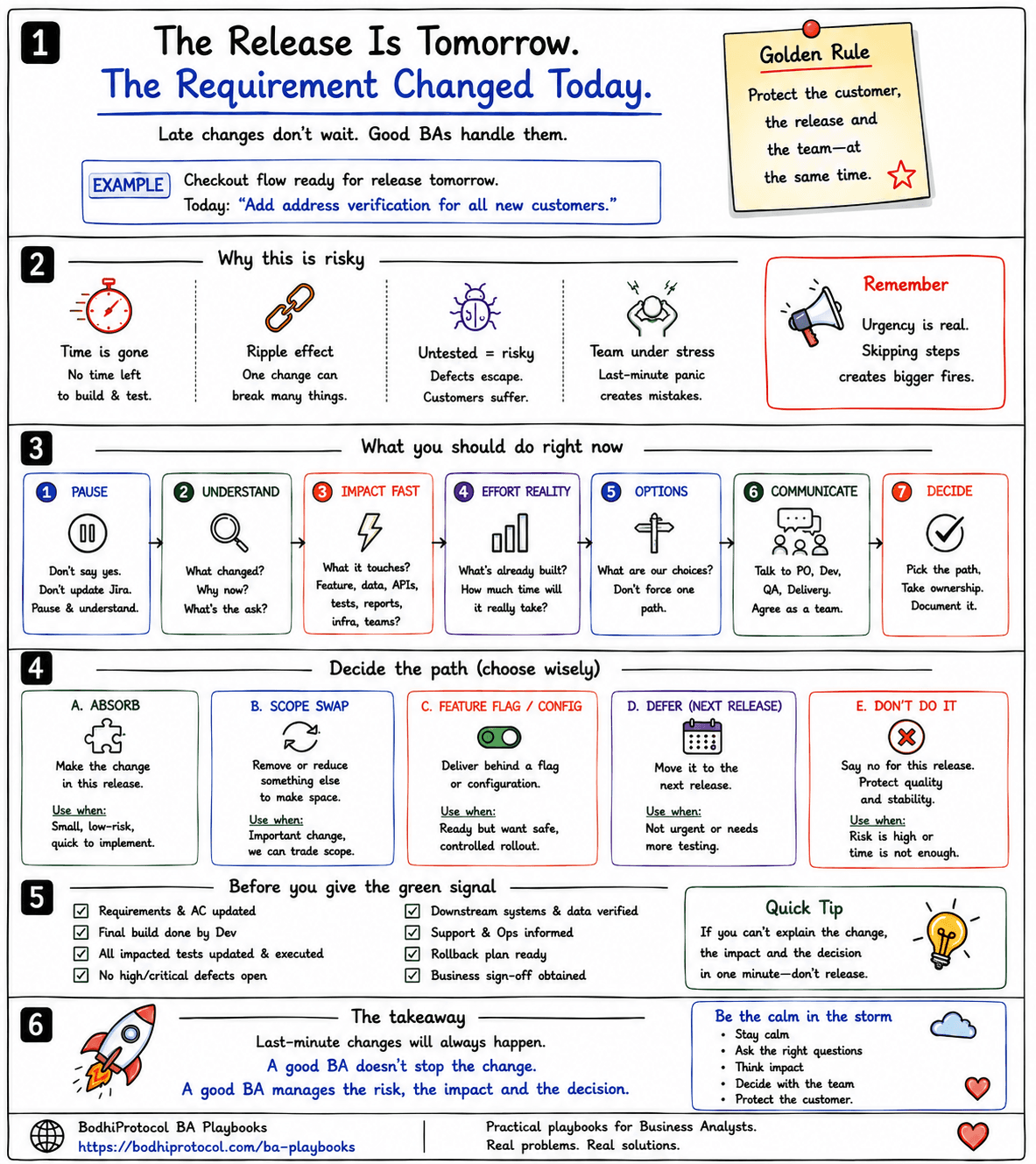
Here’s the situation
Imagine an e-commerce checkout flow scheduled for release tomorrow.
The approved requirement says:
New customers can place an order after email and mobile verification.
Today, the business adds:
“We also need address verification for every new customer.”
Sounds small.
But development and regression are complete, and Operations is ready.
That “small” change could touch:
UI → API → customer data → verification service → error handling → tests → support
The calendar says one day.
The system doesn’t care.
The first mistake: immediately editing Jira
Someone asks:
“Can you quickly update the acceptance criteria?”
Don’t. Not yet.
Updating Jira doesn’t make the system safe to release.
First ask:
What changed, what does it touch, and what happens if we get it wrong?
1. Pause — don’t commit under pressure
A useful response is:
“Let’s quickly assess the impact before we commit this to tomorrow’s release.”
That isn’t resistance.
It’s responsible delivery.
Urgency should increase discipline, not remove it.
2. Understand — what actually changed?
“Add address verification” isn’t enough.
Clarify:
| Ask | Confirm |
|---|---|
| Scope | Who/what is affected? What exactly changed? |
| Behaviour | Success, failure, retry and exception behaviour |
| Timing | Why now? Is it mandatory for this release? |
| Risk | What happens if we do not include it? |
One vague sentence can hide several business decisions.
Tomorrow is a terrible day to discover them.
3. Impact fast — what does this touch?
You may not have days for analysis.
You still need analysis.
Trace the shortest useful path:
Requirement → UI → API → Data → Rules → Integrations → Tests → Operations
Ask the people closest to the impact:
- Engineering: Which components change?
- QA: Which scenarios must be rerun?
- Operations: Does tomorrow’s process change?
- Product: What happens if we leave it out?
- Risk/Compliance: Is it optional, risk-driven or mandatory?
Fast doesn’t mean careless.
It means focused.
4. Effort reality — how long until it is release-ready?
“We can code it in two hours” is not the same as:
“We can safely release it in two hours.”
A change may need:
development + review + build + deployment + integration testing + regression + sign-off
Ask:
“How long until this is release-ready, not merely coded?”
A two-hour code change can become an eight-hour release change.
5. Options — don’t force a yes/no decision
Bring choices.
Option A — Absorb
Include the change tomorrow when the impact is small, implementation is understood, testing can finish, and risk is acceptable.
Option B — Scope swap
If the change matters but time is fixed, remove or reduce something else.
Trade scope instead of pretending capacity appeared.
Option C — Feature flag / configuration
Implement the capability but keep it controlled or disabled until ready.
Only use this when the architecture already supports it.
Option D — Defer
Keep tomorrow’s release stable and move the change to the next release with proper testing.
Sometimes the safest change is the one you don’t rush.
Option E — Do not include it
If time cannot support safe implementation and testing, say so clearly:
“We cannot demonstrate that this change can be implemented and tested safely before tomorrow’s release.”
That is not “the BA rejected it.”
It is a risk-based recommendation.
6. Communicate — get the decision-makers together
This is not a BA-only decision.
Bring together the people who understand:
- Business priority → Product / Business
- Technical impact → Engineering
- Quality risk → QA
- Release impact → Delivery / Release Management
- Operational impact → Operations / Support
- Control obligations → Risk / Compliance, when relevant
The BA’s job is to make sure everyone is deciding from the same facts.
And one point matters:
The BA informs the decision. The accountable business/release owner makes the final go/no-go decision.
7. Decide — make the decision explicit
Record:
reason → impact → owner → outcome
For example:
Address verification was requested one day before release. Engineering estimates four hours for implementation and review. QA needs three hours for impacted regression. The team agreed to defer because sufficient testing cannot be completed before the release window.
Or:
The change affects configuration only. QA confirmed impacted scenarios can be rerun before the release window. Product, Engineering and QA agreed to include it.
Much better than:
“Business said it was urgent.”
Before giving the green signal
If the change is going into tomorrow’s release, verify:
Requirement and build
- Requirement and acceptance criteria are updated
- Final build is produced
- Impacted tests are updated and executed
- Critical/high defects are resolved or explicitly accepted
- Downstream systems and data are verified
Operations and sign-off
- Operations and Support know what changed
- Rollback or recovery approach is understood
- Business/Product accepts the release decision
- Decision owner and any risk exception are recorded
If you cannot explain the change, impact and decision clearly, you are probably not ready to release it.
Take this into your next release
Last-Minute Requirement Change — Release Decision Checklist
The full seven-step framework on one printable page: pause, understand, assess impact, check release-ready time, present options, communicate and decide.
What if Compliance says it is mandatory?
Then the constraint changes.
Imagine a bank releasing a customer onboarding workflow tomorrow.
Compliance discovers a mandatory screening rule was missed.
You may not be able to release without it.
But that does not mean:
“Skip testing because Compliance said it’s urgent.”
The options may become:
fix and test → delay release → disable affected functionality
The constraint changed.
The need for impact analysis didn’t.
What if the CEO asks?
Same process.
Seniority changes priority.
It doesn’t change physics.
Code still has to work. Integrations still have to behave. Tests still have to pass.
A useful response remains:
“We can absolutely assess it. Here are the impacts, risks and options.”
The takeaway
Last-minute changes will happen.
The goal isn’t to eliminate them.
It is to stop urgency from turning into chaos.
The closer you are to release, the more expensive assumptions become.
So when someone says:
“The release is tomorrow. Can we just add this?”
Don’t panic. Don’t immediately say no. And don’t silently update Jira.
Understand the change. Expose the risk. Give the team options. Make the decision visible.
A good BA doesn’t stop change.
A good BA helps the team change safely.
A good BA doesn't stop change.
A good BA helps the team change safely.
The closer you are to release, the more expensive assumptions become. Pause, make the risk visible, present real options, and let the accountable owner make the call.
Take this with you
Last-Minute Requirement Change — Release Decision Checklist
LAST-MINUTE REQUIREMENT CHANGE
Release Decision Checklist

1. PAUSE
[ ] Said "let's assess the impact before we commit this to the release"
[ ] Did not update Jira or promise anything before that

2. UNDERSTAND THE CHANGE
[ ] Scope: who/what is affected, what exactly changed
[ ] Behaviour: success, failure, retry and exception behaviour
[ ] Timing: why now, is it mandatory for this release
[ ] Risk: what happens if we do not include it

3. IMPACT FAST
[ ] Traced Requirement -> UI -> API -> Data -> Rules -> Integrations -> Tests -> Operations
[ ] Engineering confirmed what changes
[ ] QA confirmed what must be rerun
[ ] Operations confirmed what changes tomorrow
[ ] Product confirmed what happens if deferred
[ ] Risk/Compliance confirmed optional or mandatory

4. CHECK RELEASE-READY TIME
[ ] Asked "how long until this is release-ready," not just "how long to code"
[ ] Estimate includes review, build, deployment, integration testing, regression and sign-off

5. PRESENT OPTIONS
[ ] Absorb — impact is small, understood and fully testable
[ ] Scope swap — time is fixed, traded other scope instead of inventing capacity
[ ] Flag / config — architecture already supports controlled enablement
[ ] Defer — release stability matters more than rushing the change
[ ] Do not include — safe implementation/testing cannot be demonstrated in time

6. MAKE OWNERSHIP EXPLICIT
[ ] Decision-makers were in the same conversation, working from the same facts
[ ] Accountable business/release owner made the final go/no-go call

7. BEFORE THE GREEN SIGNAL
[ ] Requirement + acceptance criteria updated
[ ] Final build produced
[ ] Impacted tests updated + executed
[ ] Critical/high defects resolved or explicitly accepted
[ ] Downstream systems/data verified
[ ] Operations + Support informed
[ ] Rollback/recovery understood
[ ] Business/Product accepts the release decision
[ ] Decision owner + any risk exception recorded

Decision record: reason -> impact -> owner -> outcome
Get new playbooks first.
Continue your BA journey
Impact Analysis TemplateFind the blast radius before production does.