BA Playbook
Nobody Knows Who Owns the Requirement
When everyone is involved, ownership can quietly belong to nobody.
Surya · August 8, 2026 · 5 min read · 3 practices
For Business Analysts stuck sending a requirement in circles between departments, BAs whose requirement docs say "Owner: Business" and nothing more specific, Delivery leads untangling who actually gets to approve a change and Anyone who's heard "ask the business" as an answer.
Someone asks:
“Who owns this requirement?”
Product says:
“Business owns it.”
Business says:
“The BA has been managing it.”
The BA says:
“Risk made the decision.”
Risk says:
“Operations needs to confirm it.”
Operations says:
“Compliance should decide.”
Compliance says:
“Isn’t this owned by Risk?”
Six answers later, we still don’t have an owner.
That’s the strange thing about requirements.
A requirement can have plenty of people around it and still belong to nobody.
Here’s the requirement
REQ-218 — Block trades when customer risk data is unavailable
The requirement says:
If customer risk information cannot be retrieved, the trade must not proceed.
Development starts.
Then QA asks:
“What exactly should happen?”
Should the trade:
- Fail completely?
- Go to Manual Review?
- Continue and be flagged afterwards?
Good question.
So the BA asks:
Who can decide?
That’s where the real problem begins.
“Ask the business”
You’ll hear this a lot.
“Ask the business.”
Okay.
Which business?
Risk?
Operations?
Front Office?
Compliance?
Product?
“Business” is not an owner.
It’s a group of people who may want very different things.
If the answer to “who decides?” is a department name, keep asking.
The BA doesn’t automatically own it
You might have:
- written the story
- run the workshops
- documented the rules
- updated Jira
- explained it to development
- supported QA
That still doesn’t mean you should make the business decision.
A BA often owns the clarity of the requirement.
Not necessarily the choice behind it.
That difference matters.
REQ-218 starts travelling
We ask Risk.
Risk says:
“Operations needs to confirm the workflow.”
Operations says:
“Compliance needs to confirm whether Manual Review is acceptable.”
Compliance says:
“Risk owns the policy.”
Risk → Operations → Compliance → Risk.
Everybody is involved.
Nobody is deciding.
This is what unclear ownership often looks like.
Not silence.
Circulation.
Find ownership at the decision point
Here’s the simplest test:
If two stakeholders disagree, who makes the final call?
That question is much more useful than:
“Who is involved?”
For REQ-218, someone eventually has to choose:
Reject or Manual Review or Continue.
The person with authority to make that choice is much closer to the real owner.
Ownership becomes visible when a decision has to be made.
Three roles worth separating
A lot of confusion disappears if we stop calling everyone the “owner.”
Requirement Owner
Accountable for what the business behaviour should be.
They can approve a material change and stand behind the outcome.
Requirement Steward
Keeps the requirement clear, current and testable.
Often the BA.
The steward makes sure everyone understands the requirement, but does not automatically make the business decision.
Decision Owner
Makes a specific specialist decision. For example:
- Risk → risk treatment
- Compliance → regulatory interpretation
- Operations → operational process
- Technology → technical design
These can be different people.
That’s perfectly fine.
The problem is when nobody knows which role belongs to whom.
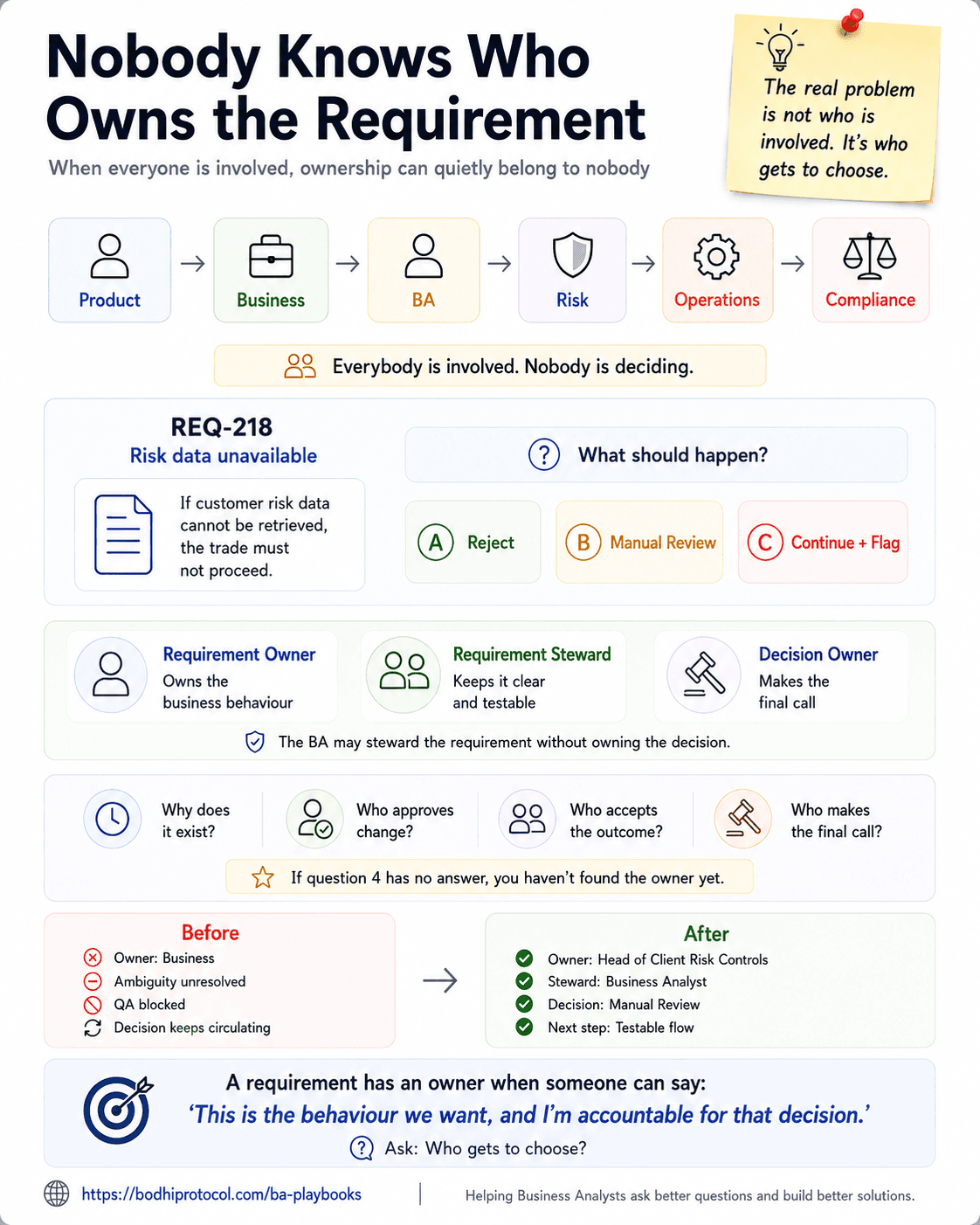
Back to REQ-218
Instead of writing:
Owner: Business
we write:
- Requirement owner
- Head of Client Risk Controls
- Requirement steward
- Business Analyst
- Open decision
- What happens when customer risk data is unavailable?
- Decision owner
- Head of Client Risk Controls
- Consulted
- Operations, Compliance, Technology
- Impact if unresolved
- QA cannot validate the exception flow.
We still need the decision.
But now we know who must make it.
That alone changes the conversation.
Instead of sending the requirement around the organisation, the BA can take the question to the person who actually has authority to resolve it.
Don’t confuse expertise with ownership
The SME may know the process better than anyone.
That doesn’t automatically mean they can change it.
The SME might say:
“This is how the process works today.”
The owner needs to be able to say:
“This is how the process should work tomorrow.”
Knowledge and authority are different things.
Both matter.
But they are not the same.
The 5-minute ownership test
Pick one important requirement.
Ask:
1. Who can explain why it exists?
2. Who can approve a material change?
3. Who accepts the business outcome?
4. If stakeholders disagree, who makes the final call?
That last question is the important one.
If nobody can answer it clearly, you probably haven’t found the owner yet.
What happened to REQ-218?
The Head of Client Risk Controls finally makes the call:
If risk data is unavailable, the trade must not proceed automatically.
Instead:
Send it to Manual Review.
Now the requirement becomes much clearer.
Business Rule
A trade must not proceed automatically when required customer risk data is unavailable.
Acceptance Criterion
Given customer risk data cannot be retrieved
When pre-trade validation runs
Then automatic processing stops
And the trade enters Manual Review.
Now we know both:
what the system should do
and
who stands behind the decision.
A requirement doesn't have an owner because a name is next to it in Jira.
It has an owner when someone says “I’m accountable for that decision.”
Next time a requirement reaches a fork in the road, don't send it around the organisation again. Ask one question: who gets to choose? If nobody knows, the requirement doesn't have an owner yet.
Take this with you
Requirement Ownership Check
REQUIREMENT OWNERSHIP CHECK

Requirement:

Why does it exist?

Requirement owner:

Requirement steward:

Who approves material changes?

Who makes the final call when people disagree?

Open decision:

Decision owner:

Impact if unresolved:
Get new playbooks first.