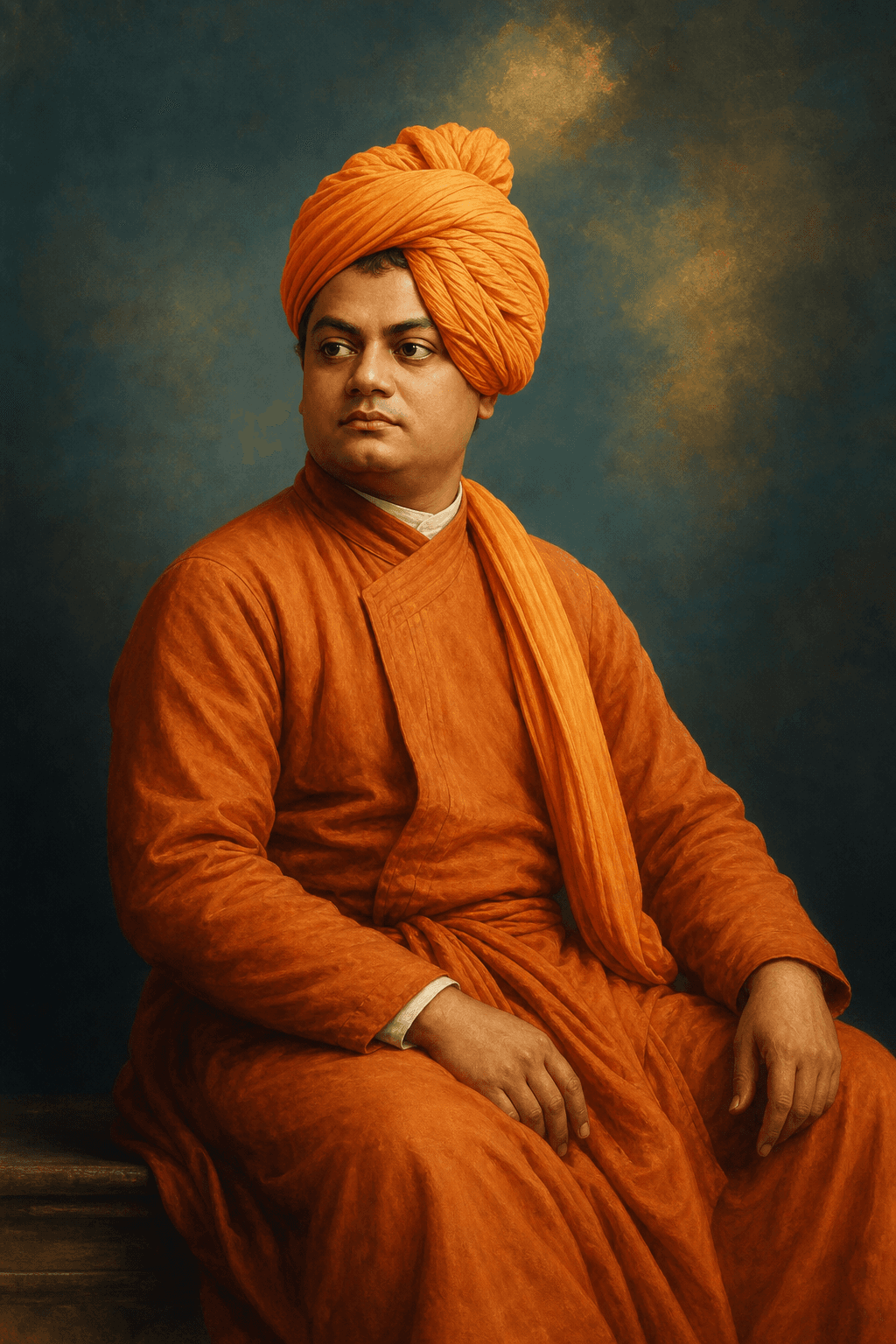
Most philosophers explain ideas.
Vivekananda converted them.
At the widest point of his mind sat one profound philosophical truth: each soul is potentially divine. But he did not leave that sentence suspended in the air. He forced it through the funnel of life until it became strength, service, education, and national awakening.
That is what makes him unusual. He took one of the most abstract ideas in Indian philosophy and compressed it until it became action.
The Central Thesis
Vivekananda's mind was a converter. He took the abstract Vedantic idea that every person already carries divine potential and compressed it into practical action through strength, service, education, and nation-building.
Core Philosophy
Vivekananda's core move was Practical Vedanta. Vedanta had existed for centuries; his innovation was not inventing a new philosophy, but forcing an ancient idea to become useful. If each soul is potentially divine, then religion cannot remain trapped in temples, monasteries, books, or debates. It must enter schools, hospitals, workplaces, villages, and everyday conduct. Meditation should make you fearless. Knowledge should make you compassionate. Faith should make you useful. A philosophy that does not change how you live on Tuesday morning is still incomplete.
Vivekananda compressed ideas until they became action.
Transferable Frameworks
Mental Models
Practical Vedanta
Religion is not primarily about beliefs. It is about transformation. A philosophy becomes real only when it changes daily behavior.
Strength Before Perfection
Strength comes first; perfection comes later. Fear freezes growth, while courage accelerates it. Even imperfect action taken bravely beats perfect plans never attempted.
Jiva Is Shiva
Every human being deserves dignity because the divine exists within every person. Service is not charity beside worship; it is worship itself.
Unity Without Uniformity
Harmony does not require sameness. People may travel different roads while moving toward the same destination.
The Invisible Teacher
Great teachers eventually disappear into their students. Education should produce confidence rather than permanent dependency.
Do not admire the ideal. Convert it.
How They Thought
Thinking Process
- 01
Begin with the highest possible truth
Instead of asking how people become worthy, he began by assuming they already possessed infinite potential. People were not empty vessels waiting to be filled; they were powerful beings waiting to discover what already existed within them.
- 02
Filter everything through strength
Whenever he encountered an idea, custom, or belief, the implied test was simple: does this make a person stronger or weaker? If it produced courage, confidence, discipline, and self-respect, it deserved to survive. If it encouraged fear, dependence, or passivity, it deserved to disappear.
- 03
Translate philosophy into behavior
Truth had no value if it remained inside books. A spiritual insight had to become practical: in speech, work, education, service, and daily courage.
- 04
Look for unity beneath difference
Where others saw competing religions, Vivekananda searched for underlying structure. Different traditions could use different symbols, languages, rituals, and stories while still climbing the same mountain from different directions.
- 05
Build people who no longer need you
The best teacher is not the one with the most followers. The best teacher creates independent thinkers. Success is measured by what students can accomplish after the teacher disappears.
The teacher succeeds when strength continues without him.
The Output
Big Ideas
Practical Vedanta
Vivekananda's innovation was making Vedanta practical: philosophy should leave temples, monasteries, and books and enter schools, hospitals, workplaces, villages, and everyday life.
Chicago, 1893
At the Parliament of the World's Religions, he introduced Indian philosophy to a global audience with confidence rather than defensiveness, reframing Hinduism as a universal philosophical tradition capable of modern dialogue.
Man-making education
He believed India's greatest shortage was not intelligence, but confidence. Education should produce character, courage, disciplined minds, and the ability to solve real problems.
Institutions matter
Ideas disappear unless institutions preserve them. The Ramakrishna Mission turned his philosophy into schools, hospitals, disaster relief, education, and organized service.
The Engine
Truth Becomes Transformation
Truth becomes self-belief. Self-belief becomes strength. Strength becomes fearless action. Fearless action becomes service. Service becomes social transformation.
The Bespoke Engine
The Vivekananda Engine
Every major contribution followed the same conversion sequence: an inner truth became self-belief, then strength, then fearless action, then service, then social transformation.
Truth
Each soul is potentially divine.
Self-Belief
Identity shifts from lack to latent power.
Strength
Confidence becomes discipline and self-respect.
Fearless Action
The idea leaves the book and enters Tuesday morning.
Service
Dignity becomes work for other people.
Social Transformation
Individuals, communities, and nations become stronger.
Everything begins with changing how people see themselves.
The Life, Briefly
Timeline
- 1863
Born as Narendranath Datta in Calcutta.
- 1881
Meets Sri Ramakrishna and spends years questioning him before accepting him as his spiritual teacher.
- 1886
After Ramakrishna's death, takes monastic vows and begins the journey that will make him Swami Vivekananda.
- 1888-1893
Travels across India as a wandering monk, witnessing poverty and social inequality firsthand.
- 1893
Represents Hinduism at the Parliament of the World's Religions in Chicago and gains international recognition.
- 1897
Establishes the Ramakrishna Mission, combining spirituality with organized service.
- 1899-1900
Undertakes a second journey to the West, expanding Vedanta societies across Europe and America.
- 1902
Passes away at Belur Math at the age of thirty-nine.
His public life was short; the conversion engine he left behind kept running.
Why It Still Matters
Enduring Influence
Practical Vedanta
Ancient
Divine potential as a philosophical truth.
Modern
Values that must show up in behavior, institutions, and public service.
Why It Matters
A principle that never changes action is still mostly decoration.
Strength Before Perfection
Ancient
Fearlessness as spiritual discipline.
Modern
Confidence-building before complex capability-building.
Why It Matters
People cannot use opportunity well while trained into helplessness.
Jiva Is Shiva
Ancient
Seeing the divine in every being.
Modern
Dignity-centered education, healthcare, relief, and social work.
Why It Matters
It makes service reciprocal in spirit, not paternalistic.
Go Deeper
Books & Resources
Karma Yoga — Swami Vivekananda
The clearest explanation of action as a spiritual discipline.
Raja Yoga — Swami Vivekananda
A systematic exploration of meditation, concentration, and mastery of the mind.
Jnana Yoga — Swami Vivekananda
The philosophical foundations of Advaita Vedanta.
The Complete Works of Swami Vivekananda — Swami Vivekananda
The definitive primary source for understanding his lectures, letters, and ideas.
Scholarship Notes
- Some famous lines associated with Vivekananda circulate in paraphrased form; this page treats them as public teaching motifs rather than narrow textual proof-points.
- His influence on Indian nationalism is significant, but he was not a party-political figure in the later twentieth-century sense.
Most people spend their lives asking: How do I become enough?
Vivekananda reversed the question.
You are already enough. The real challenge is discovering the strength already within you and expressing it through fearless action.
That single inversion explains almost everything he taught: from weakness to strength, from dependence to self-belief, from contemplation to action, from the individual to the nation.